The new lane changes and other measures introduced on parts of the VOAK over the past year will, it is hoped, do much to reduce the fatal accidents which have long blighted the highway’s safety record. In particular, they should reduce the likelihood of head-on collisions which have been the main source of fatalities.
Too often, the victims have been young drivers with limited road experience, many driving older cars which lack up-to-date safety features. Usually, when such an accident occurs, local press reports focus on the premature loss of young lives and the devastating effects on their families, discretion preventing them from raising the question of whether the victim was in any way responsible for the fatal outcome. Instead, attention is always focussed on the road conditions, lack of adequate signage, poor visibility caused by untrimmed vegetation, etc. Indeed, we have not seen a single report of a fatal accident which has raised the simple question of whether the driver was wearing a seatbelt – a practice which far too many Cretans still seem averse to.

Yet the fact remains that poor driver discipline is common among young motorists who do not have sufficient experience to resist the many potential distractions offered by mobile phones and in-car entertainment systems, or to realise that bravado and unbridled emotion can easily lead to dangerous situations. A Europe-wide survey of young drivers’ behaviour, reported last weekend in the Haniotika Nea, highlights a number of common faults:
Alarm bells ring over young people’s behaviour behind the wheel
Enraged drivers ready for a fight who easily resort to insults, the overwhelming majority of them busy with their mobile phones while they are driving, make up the picture of Europeans at the wheel, while even more concerning is the behaviour of young drivers from 16 to 24 years old. Moreover, in some categories, Greeks are in the lead as lawbreakers.
These especially concerning results have emerged from the latest annual survey carried out by Ipsos BA, which involved 12,100 people in 11 European countries and recorded the behaviour and attitudes of European drivers. The VINCI Autoroutes Foundation has published the results of the 16th Responsible Driving Barometer which enables the monitoring of trends in risky behaviour and the identification of best practices, helping to improve the targeting and effectiveness of prevention messages.
Despite a 3% reduction since 2024, the number of fatal road accidents in Europe remains disturbingly high, with nearly 19,800 deaths annually. The survey’s findings should cause intense concern, and prompt the authorities to seek ways of drastically reducing, in particular, the dangerous driving habits of young drivers from 16 to 24 years of age.
Among the findings about young drivers in both Greece and Europe are the following:
– Almost 9 out of 10 young people use a smartphone or program their GPS while driving (82% of Greeks against 88% in Europe).
– 46% of young Greeks send or read text messages or emails while driving (39% in Europe).
– 49% drive while feeling very tired (40% in Europe).
– 48% drive without fastening their seatbelt (22% in Europe).
– 16% admit to driving sometimes under the influence of alcohol (7% in Europe).
– 3% drive after using narcotics such as cocaine, ecstasy etc (4% in Europe).
(Haniotika Nea, 06/06/26)
Driver confidence and aggression
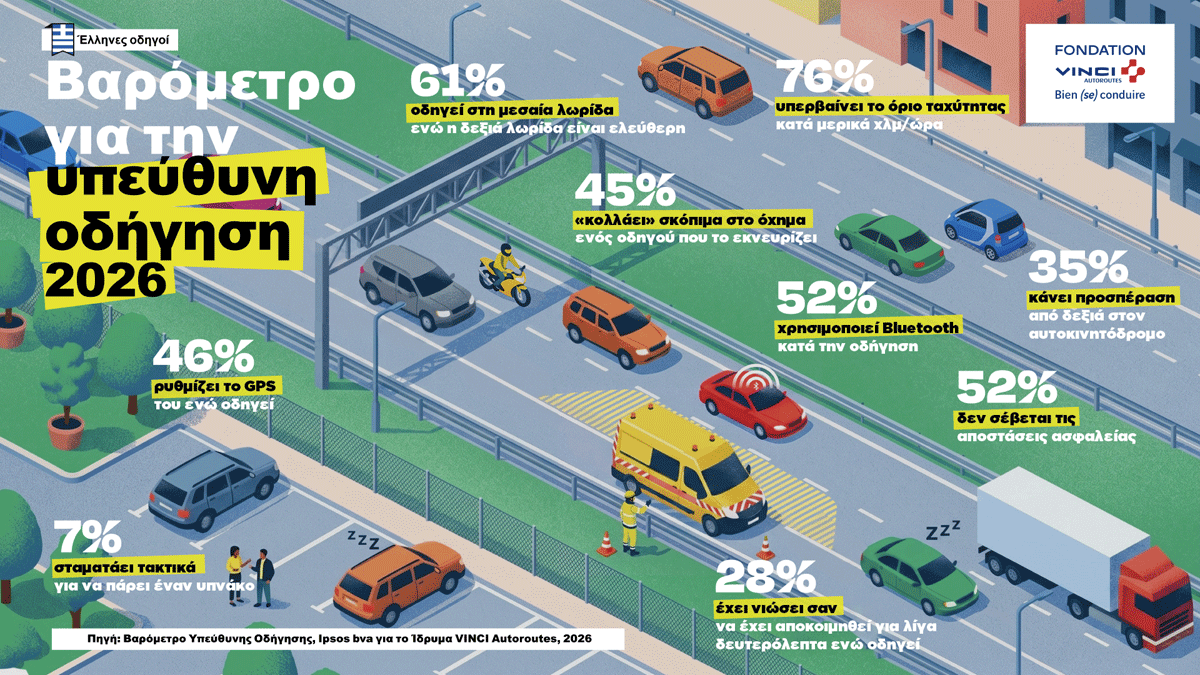
Just as concerning is the more general picture of driver attitudes, which often lead to dangerous behaviour. Drivers are generally inclined to rate their own driving favourably and that of other drivers negatively. The survey found that 97% of Europeans (and 97% of Greeks) use at least one favourable adjective to describe their attitude on the road. Most think that they drive carefully (73% of Europeans, 77% of Greeks), and almost 1 in 4 declare that they have a courteous attitude behind the wheel (24%, 20%). Almost never do they consider themselves aggressive (2%, 3%) or irresponsible (1%, 0.5%). The following infographics illustrate the main problems of driver discipline among Greeks as a whole.