If called upon to identify the three institutions which have contributed most to the stability of Greek society through its many hardships and crises, one would probably name the family, the Orthodox Church and the kafeneion. The most characteristically Greek of the three, the kafeneion was actually introduced to the country during the centuries of Ottoman rule. Popular histories relate that the first coffee shop opened in Constantinople in 1475, while by the 18th century the kafeneion was a well established part of Greek social life.
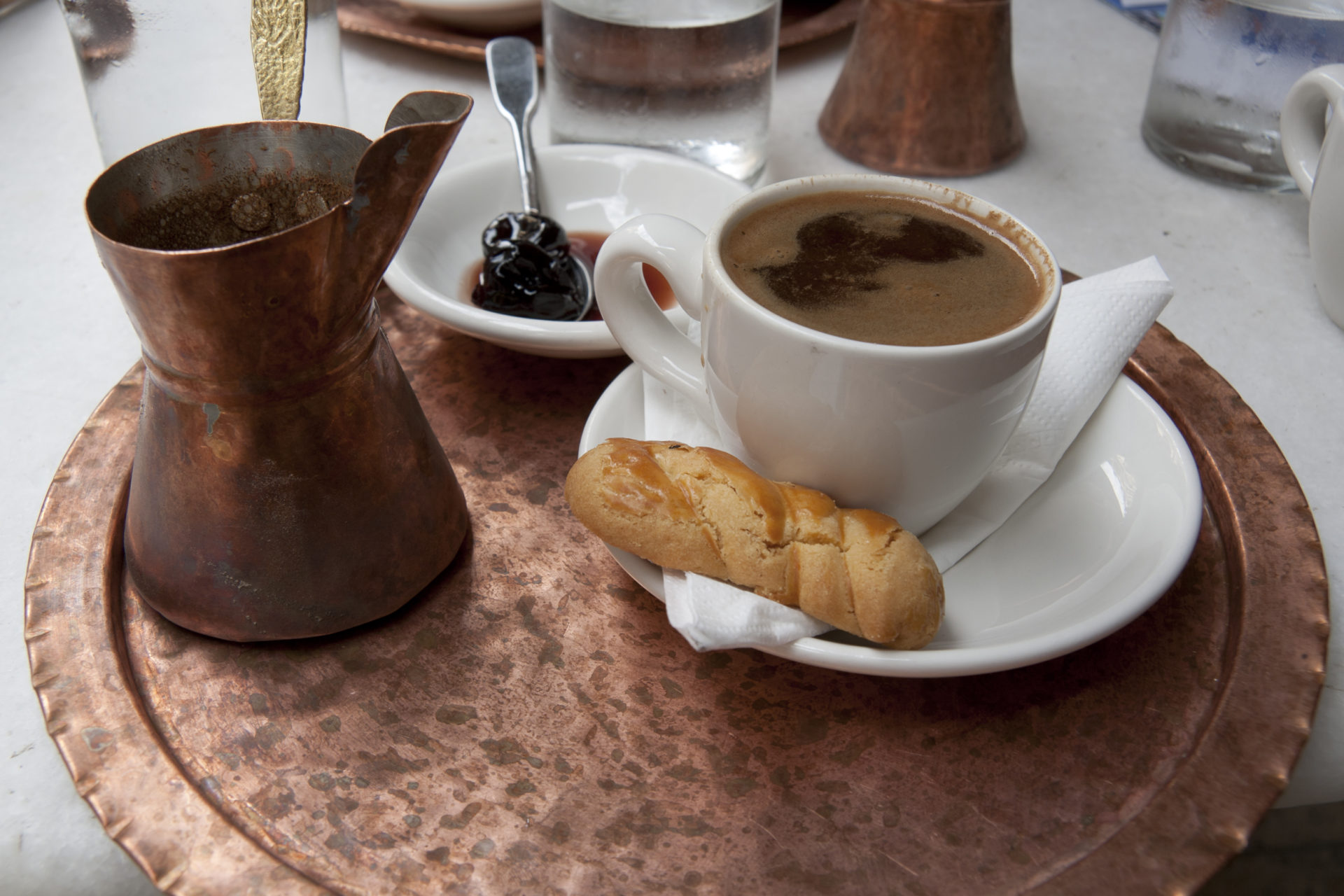
The method of making coffee in a briki over a flame or hot sand was for generations known as Turkish coffee, but following the Turkish invasion of Cyprus in 1974 a wave of nationalism ensured that the drink, in Greece, was henceforth known only as Greek coffee.
The visit to the kafeneion, traditionally a habit of older males, was and still is an opportunity to get out of the house, meet friends and have one’s daily shot of caffeine, while discussing the state of the world, the weather, the crops, and whatever else is topical. Conversations at the kafeneion in Afrata village (or in summer at the beach bar) still revolve mainly around the livestock, grapes and olives which occupy the lives of many of its inhabitants, while discussions of food and the methods of preparing it also figure largely.

In towns and cities, cafés and modern coffee bars cater to a more mixed and younger clientele. The ubiquitous Greek coffee has also been partly replaced by alternatives derived from the global coffee culture, adapted to Greek tastes and climate. The frappé is the essential take-away coffee, made quickly by frothing up instant coffee with water and ice, and adding milk or sugar to taste. Served in a paper cup with a domed plastic lid with a straw, it can be sipped slowly while working or driving, and is frequently disposed of by decidedly non-ecological methods. Also, espresso machines have become an essential piece of equipment, providing Italian-style coffee in all its variations, including the chilled espressos and cappuccinos which are popular in the summer heat.
Coffee remains the most popular drink in Greece, and TV coffee advertisements plug into its association with key moments of daily life: a pick-me-up before leaving for work, a reflective pause at the end of the day, the emotional satisfactions of a visit to ageing parents and so on. While going out for a coffee remains an essential feature of Greek life, these ads reflect a growing trend towards preparing it at home.
Survey reveals fewer visits to the kafeneion
The continuing pressure on prices generally, caused by a combination of factors including climatic change and global instability, is slowly bringing about a change in Greek consumer habits, with coffee nevertheless proving a particularly resilient category in the market.
Data on the European retail market from the NielsenIQ analysis group, which were presented at the 1st Panhellenic Coffee Symposium held in Athens on 1st October, depict a consumer who is more careful in their expenditure, but at the same time determined to preserve small daily satisfactions, such as coffee.

While almost two out of three consumers state that they intend to reduce their outgoings on food, and 46% say that they will be visiting cafés and cafeterias less often, at the same time coffee remains one of the most popular choices in the out-of-home environment. In NielsenIQ’s research on Greece, coffee constitutes 57.9% of the drinks consumed in catering establishments, close to beer. Forty-three per cent of respondents declare that they visit coffee establishments once or twice a week, while almost 9 out of 10 visit a café. At these places, coffee – either hot or cold – constitutes by far the main choice, at 74%.
Increase in retail spending
Increases in purchases of packaged coffee confirm a trend towards home consumption. Almost six out of ten buyers state that they bought packaged coffee or tea on their last visit to the supermarket. At the same time, the category acts as the motivation for a shop visit in 22.6% of cases.
In terms of volume, coffee is moving faster than the whole FMCG (fast-moving consumer goods) market. The NielsenIQ survey records an increase of 10.1% for coffee in the retail trade over last year, against 5.5% for all the FMCG categories which it tracks. In terms of value, coffee is in third place among the 171 FMCG categories examined by Nielsen IQ, behind cheese and milk. The total value of sales in 2025 reached €501.4 million, an increase of 13.7% over 2024. The average annual increase in the category for the period 2018-2025 was 6.5%.
This development is due to a mixture of increased demand, especially during the pandemic and after, followed by increased costs of raw materials and the Special Consumer Tax (EFK). At the same time, domestic machines for making hot drinks sold 403,000 units in 2025, an increase of 17.5% over 2023, continuing an upward trend which reached the threshold of 300,000 units in 2020.
As the figures demonstrate, the Covid lockdowns forced people to make their own coffee at home, forming a habit which persisted once the pandemic had ended, and has now become an advantage at a time of steadily rising prices.
(www.protothema.gr/APE-MPE)